- Home
- What we mill
Kestrel Granary · Schedule of work
What we mill, and who we mill it for.
Three lines of work run out of one building on Dike Road: sacks of flour for people who bake for a living, a store counter for people who bake at home, and a cleaning room that belongs as much to the growers as it does to us.
Service 01 · 50 lb · net
Wholesale flour
We sell to bakeries, restaurants, pizzerias and a few brewers, in fifty-pound cotton sacks and twenty-five pound multiwall paper. Every wholesale order is milled to order, usually the day before it goes on the truck, which is the whole reason to buy from a mill an hour up the road instead of a distributor.
A first conversation takes about ten minutes. You tell us what you bake, how much flour a week it eats, and how you ferment. We tell you which of our grains behaves that way and send a twenty-five pound sample sack on the next run out to you. Nobody signs anything. If it works, we put you on a standing order and you stop thinking about flour.
Standing orders are confirmed by text on a fixed cutoff: Monday 2pm for the Bellingham run, Monday 4pm for Seattle because the truck loads Tuesday night, and Wednesday noon for Anacortes. Change the quantity any time before the cutoff and we will grind to the new number. After the cutoff it is already in a sack with your name on the tag.
Pricing is per pound and moves with what we pay growers, not with what commodity wheat does in Chicago. It is the same price whether you take Edison or emmer at the same poundage, and it steps down at five hundred pounds a week. We publish a price sheet twice a year, in March and September, and we do not change it in between.
The tag stapled to every sack carries the variety, the field, the lot number, the mill date, the protein and the falling number. If a bake goes wrong, read us the lot number and we can pull the same flour off our shelf and bake it here.
- 50 & 25 lbSack sizes
- 100 lbSmallest delivered order
- 3 runsBellingham, Seattle, Anacortes
Service 02 · Retail counter
The mill store
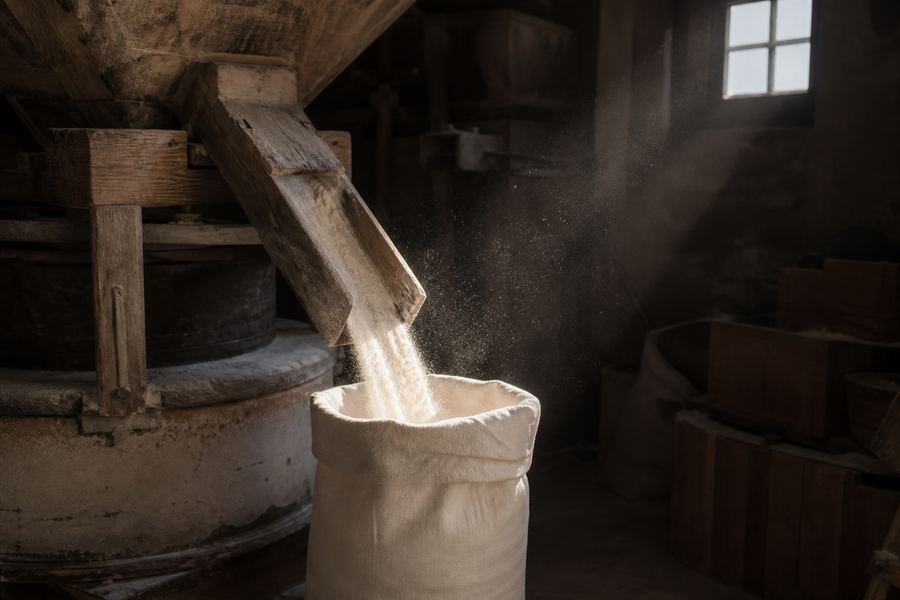
Side door, under the grain leg, past the pallet jack. Thursday, Friday and Saturday, 9am to 4pm. There is no sign on Dike Road worth mentioning, so look for the silo.
What is on the shelf on any given day depends on what came off the stones that morning. Rye is ground Thursday early, so Thursday is the day to come for it. Edison and Yecora are milled most days and are always there. Emmer and buckwheat move slowly enough that we bag them once a week, and triticale usually is not on the shelf at all because the brewers take it in bulk.
Flour comes in quart jars, two-pound kraft bags and five-pound bags. Bring a clean jar back and we will fill it and knock the jar price off. There is a scale on the counter if you want an odd weight, and a chalkboard with what was milled that morning and when.
We keep a shelf of grain berries too, for people who mill at home: Edison, Yecora, rye and buckwheat groats, by the pound. If you own a home mill and have never run our wheat through it, ask before you buy five pounds. Some of the small stone burrs choke on grain cleaned to seed standard rather than to flour standard.
Card or cash. No online store and no shipping, which disappoints people from out of state, but a two-pound bag costs more to post than it does to buy and it arrives warm.
Two open days a year, one in April and one in October, we run the mill with the doors up and let people onto the floor. Ask at the counter to go on the list.
| Thursday | 9am – 4pm |
|---|---|
| Friday | 9am – 4pm |
| Saturday | 9am – 4pm |
| Sun – Wed | Closed |
| Quart jar | Roughly 1 lb 6 oz of flour |
|---|---|
| 2 lb bag | Kraft, folded and taped |
| 5 lb bag | Kraft, the usual weekly bag |
| Berries | By the pound, four varieties |
Service 03 · Toll work
Custom milling & grain cleaning
Bring your grain, take back your grain. We clean and mill on a toll basis for growers around Skagit, Whatcom and Island counties, and for two bakeries that contract their own acres and want to know exactly which field their flour came out of.
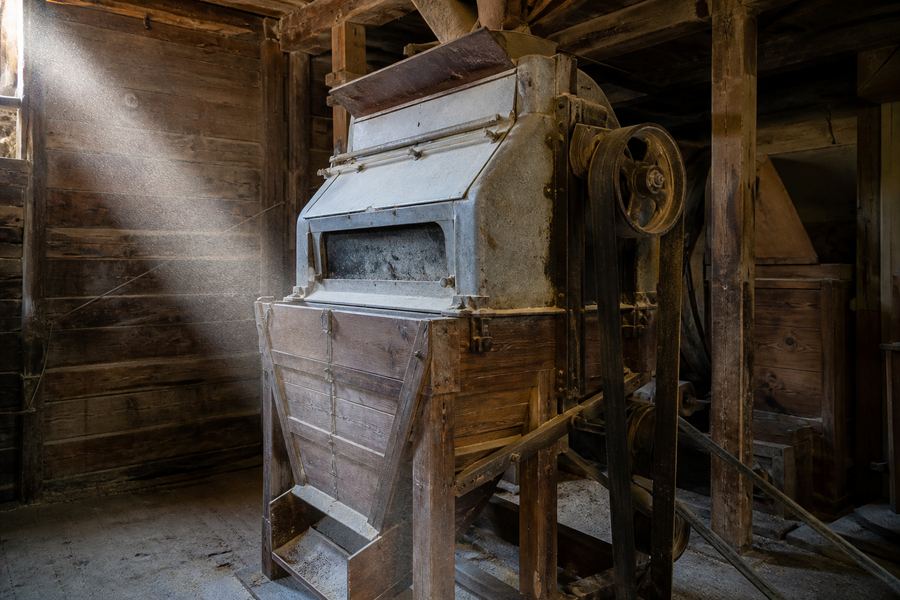
The cleaning room is a 1954 Clipper No. 27 fanning mill and a gravity table. Between them they pull chaff, straw, stones, weed seed and anything light or badly filled. Growers use it for seed stock as often as they use it before milling, and plenty of the work that comes through here never touches the stones at all.
Minimum is five hundred pounds, in totes or on pallets, dry to fourteen percent or under. We will test moisture on arrival and turn away anything wetter, because wet grain gums the stones and costs a day of dressing to fix.
How a toll job runs
Call before you load
Tell us the crop, the tonnage and the moisture. September through November the cleaning room books out about two weeks ahead, and turning up unannounced with a tote on the forklift is how you end up taking it home again.
Drop and test
Grain comes off at the north door. We take a moisture reading and a test weight in front of you and write both on the ticket. Anything over fourteen percent goes back on your truck.
Clean
Through the Clipper, then the gravity table if the lot warrants it. Screenings come back to you with the finished product unless you tell us to keep them, and most growers want them for stock feed.
Mill, if you want it milled
Whole or sifted, your call on the grind. We run toll lots at the end of a day and clean down the stones before and after, so your flour is yours.
Bag and collect
Fifty-pound sacks or back into your own totes. Cleaning runs nine cents a pound, milling twenty-two, and there is no charge for the tote if we already have it on the floor.
Bin list
What is in the bins right now
Six things, and when one runs out we say so on the phone rather than quietly sending you something close.
| Grain | Type | Protein | Grinds | Notes |
|---|---|---|---|---|
| Edison | Hard red spring wheat | 12.4–13.1% | Whole or sifted to 85% | Our bread flour. Halverson place, Fir Island. |
| Yecora Rojo | Hard red spring wheat | 13.2–14.0% | Whole or sifted to 80% | Thirstier and faster-browning. Long ferments. |
| Skagit rye | Winter rye | 9.6–10.4% | Whole, medium or fine | Ground Thursday mornings for the store. |
| Emmer | Farro piccolo | 12.8–13.6% | Whole | Pasta, porridge, and a share of the pan loaves. |
| Triticale | Rye × wheat cross | 11.5–12.2% | Whole or cracked | Brewers take most of it. Dykstra, Beaver Marsh Road. |
| Buckwheat | Groats, hulled | n/a | Light or dark grind | Not a wheat, and not milled gluten-free. |
Protein figures are the range measured across this crop year, not a specification.
Questions we get asked
Before you call
Do I need a wholesale account to order?
No paperwork to start. Call the mill or send a note through the contact page with the varieties, the grind and roughly what you go through in a week. Wes will price it and tell you which run you fall on. We ask for a business name and a resale certificate before the second delivery, not the first.
What is the minimum order, and what does delivery cost?
It depends on the run. Bellingham is a hundred pounds a stop, Anacortes and Fidalgo is fifty, and Seattle is two hundred or two neighbours splitting a two hundred pound drop. Delivery inside those windows is included in the flour price. Anything outside them ships freight collect, and honestly we will usually tell you to find a mill closer to home.
How fresh is the flour, and how should I store it?
Wholesale flour is milled the day before it goes on the truck. Store flour is ground that week. Because we leave the germ in, the oil in it will go off the way oil does: keep sacks somewhere cool and dark and use them inside eight weeks, or freeze what you cannot get through. If a sack ever smells like crayons, call us and we will replace it.
Can I swap this straight across for the flour I buy now?
Not straight across, no. Stone-ground flour with the bran still in it drinks more water and ferments faster than roller-milled white. Most bakers land somewhere between five and eight percent more water and pull the bulk twenty minutes earlier. Start at seventy percent of your usual flour by weight for a fortnight, then go up. We are happy to talk through a formula on the phone before you commit a mix.
Is any of it gluten-free?
No. We mill buckwheat, which is not a wheat, but it goes through the same stones and the same bagging line as hard red spring and rye. There is no honest way to call it gluten-free and we will not print it on a tag.
Will you clean grain for a farm outside Skagit County?
Yes, within reason. Most of the custom work comes from Skagit, Whatcom and Island counties. We have cleaned seed for growers as far out as the Methow when the timing worked. The limit is the calendar rather than the map: between September and November the cleaning room is committed, and lead times run close to two weeks.
Are you open to the public?
The store is, Thursday through Saturday, 9am to 4pm. The mill floor is not, except on the two open days we run in spring and autumn. Monday through Wednesday the stones are turning and the aisles are full of pallets, so please do not knock.
Wholesale · store · custom milling
Call the mill and ask what is in the bin.
Nell or Wes picks up between 7:30 and 3:30 on weekdays. If we are on the floor and the stones are loud, leave a message with the variety and the poundage and you will hear back the same day.